Member for

12 years 2 months
Submitted by Lake Huron Cen… on

They're Back, Baby!

An endangered shorebird has begun nesting on Lake Huron beaches, and that’s a good sign for people concerned about good lake health.
 
Piping Plover -July-2014 167
     (photo credit: Carolyn Hann)
The tiny Piping Plover has made its way back to Sauble Beach to nest for the eighth consecutive year. Before that, it was absent from Great Lakes shorelines in Ontario for 40 years. It’s very picky where it nests, but it’s no coincidence that it is preferring high quality beaches where beach and dune conservation efforts have taken place.
 
Two nests are currently at Sauble Beach, and a nest has appeared for the first time in Port Elgin, at the main beach. Wasaga Beach Provincial Park is also a nesting destination for some Plovers.  The birds and their young  present some challenges for beach managers and beach-goers since they do need some space to do their thing. But it is possible to beach in harmony with the little birds. It takes a bit of patience, and an understanding that these are an endangered species.
 
In fact, their dubious distinction makes them a bit of an attraction. Plovers are endangered throughout North America. This isn’t lost on the many birders who come to get a glance, or a photo, of this tiny beach bird.

Aside from their rarity, these birds provide an indicator, or 'marker,' of good beach quality. And, as it happens, each of these three Ontario beaches have undertaken conservation measures that have improved beach sand quality and quantity, restored the natural dunes, reduced erosion and improved local water quality. So when the Piping Plover comes to nest, that tells us  our shores must be doing all right.
 

Plover Report for Sauble Beach:
  • four pairs on the beach this year.
  • lost two nest to predation, possibly a weasel or mink; however, both pairs re-nested. 
  • the first pairs clutch hatched on July 6.
  • only 2 of the 4 eggs hatched and both chicks were taken — one by a gull the first day and the other the following morning by a gull or merlin.
  • there are 3 nests left on Sauble Beach and they are due to hatch July 17, 24, and 27th.

Plover Report for Port Elgin Beach:
  • a total of 4 chicks hatched on June 23. 
  • the chicks are doing well and are starting to stretch their wings. 
  • they are also getting quite big now at 2.5 weeks old.
  • the female and male are still caring for the chicks.
     
Threats to Beaches:
 

Tips for Protecting Plovers:

  • stay out of fenced-off beach areas as this is important habitat for plover nesting and raising young
  • keep pets off the beach, and make sure they are on a leash
  • if you see a Piping plover, please keep your distance
  • do not feed the gulls, as these birds will prey upon the plover’s eggs and chicks
  • put your garbage in the proper receptacle. Gulls can be attracted to garbage on the beach
  • look for volunteers on the beach wearing orange vests and feel free to ask questions and view the plovers with them
  • if you'd like to volunteer to watch over the Plovers, contact Craig Todd at the Ministry of Natural Resources - craig.todd@ontario.ca

Learn more about Piping Plovers click here.

[article by Geoff Peach, Coastal Resources Manager]

Just Average??

 
 waves

Water levels on Lake Huron have been low so long, that a rebound to average conditions is a cause for celebration. Since 1998, when levels dropped dramatically, and then remained low until early last year, people have wondered if we’d ever see ‘normal’ conditions again. Well, some really wet seasons, including the large accumulations of snow and ice cover of this past winter, show how quickly things can change on such a big water body.

After an unusually cold winter in the Great Lakes region, Spring 2014 was also cooler than normal, coming in as the 5th coldest on record since 1948. Great Lakes ice cover reached  92.5% by early March, making it the second greatest amount of ice cover since record keeping began in 1973.

2014 has seen a larger-than-average seasonal lake level rise, bringing Lake Huron, to just 16 centimetres below the 1918-2013 average and making the Great Lake 35 centimetres higher than the same time last year. In January 2013, levels on Lake Huron marked a record low, 70 cm. below ‘chart datum’. Since then, the rebound has been remarkable, rising over one metre since that low point.
 
[Note: reliable water level records on the Great Lakes began in 1918, so the historical record typically refers to that start point. Also, from a hydrological standpoint, Lakes Michigan and Huron are considered to be a single lake, due to the deep Straits of Mackinac that connect them. The level on Lake Michigan is the same as the level on Lake Huron.]


May 2014 Water supplies were well above average during May on Lake Michigan–Huron causing this lake’s level to rise by 16 cm, double its average May increase of 8 cm and the sixth highest May rise on record
 
April 2014 Water supplies in April were also well above average on Lake Michigan–Huron causing this lake’s level to rise by 20 cm, nearly double its average April increase of 11 cm and the sixth highest April rise on record. Looking back to the year before, Lake Michigan–Huron’s level rose by 24 cm, more than double its average. The 24 cm increase was only 1 cm less than the record April rise of 1951

[sources: Environment Canada; US National Oceanic and Atmospheric Administration]


More on Lake Levels - click here.

Lazy Days of Summer

During those hot summer days when all you want to do is lounge with a cold beverage, there aren't too many activities that will get you moving.  But if you focus all of your energy, a fun activity that doesn't require you to leave your lounge — is making a donation to the Coastal Centre! You can do it the old fashioned way and write a cheque (requires about 0.032 kilo joules of energy expenditure), or the new-fangled method through your tablet or smart phone (needs about 0.026 kilo joules of energy). Either way, you won't even break a sweat. How cool is that?

 You can donate online through CanadaHelps, or send a donation cheque by mail. For more information on donating to the Centre, visit our donate page.



Member for

12 years 2 months
Submitted by Lake Huron Cen… on

A MATTER OF ETIQUETTE

I've often heard from cottagers fed up with the way some people treat our local beaches. Some are just small matters of beach etiquette that, if ignored, can add up to a big mess — and an environmental problem. In honour of Emily Post, we present the following tips on proper beach etiquette. You might want to post these in a conspicuous place where visitors to your beach can read and learn.

Don't bring glass containers:  Leave your glass containers at home. Use plastic and paper (that you can recycle) when you go to the beach. Most people are barefoot, and you don’t want to cause injury to humans or their beloved pets, if the glass breaks.

Can you dig it? Sure, but fill it in afterwards:  Like a golfer replacing a divot, beach goers who like to dig in the sand need to fill in their holes when they are done. Sand castles and holes left on the beach can pose a hazard to others walking along the shore, particularly people with low vision or walking after dark.

Bring a bag to collect litter as you walk on the beach: Many of the wildlife who live in and around the water do not chew or taste their food. They just gulp it! Even tiny pieces of litter can hurt wildlife, so please be sure to dispose of your garbage and recyclables in the proper place.

The Beach is NOT a Big Ashtray:  When you go to the beach, try to enjoy the fresh lake air. Smoking ruins the total beach effect, and it really annoys others who are downwind. If you can’t go an hour without a smoke, separate yourself from others and make sure you are the one who is downwind. Dispose of your cigarette safely in a garbage receptacle, not the sand. Cigarette butts are a big polluter on our beaches, and a danger to wildlife if ingested.

Don't feed the wildlife:  Birds and other animals at the beach can find their own food that is much healthier than the over-processed, salted, high-fat snacks in your picnic basket. Seagulls are good at begging and hovering. If you feed them, you may make them even more aggressive.

Dispose of your litter properly:  Most public beaches have garbage or recycling cans positioned in strategic locations so you don’t have to walk too far to get rid of your garbage. Never toss it into the water or leave it on the sand for others to pick up: no one likes walking around litter on the beach.

Leave the beach cleaner than you found it: Human-generated garbage (like plastics) often ends up on the beach. This can kill shore life (fish, birds, etc.) that either becomes entangled in it or ingests it. It is collectively our responsibility to clean up our garbage!

Beach Fires:  Many public beaches no longer allow fires on the beach. But for those areas where it is still allowed, make sure your fire is fully extinguished before you leave it. Build your fire near the water's edge so that embers do not float up and into treed areas or worse onto cottages.  Do not have fires during the day or night when it is windy.  If you start a fire when there is no wind but the wind gets up, immediately put out the fire. Spread the wood and coals out and pour water on it.  A bonfire that is not put out completelty can smolder for hours, which is a nuisance for your neighbours.  Many beach users have been victim to thoughtless people who haven’t put out their fire properly, only to step on a still burning ember the following day.

Follow the posted rules:  Most public beaches have rules posted near the entrance. Read them and follow them. They are for the safety and enjoyment for everyone.  These rules are very applicable to private beaches too!

We hope that these etiquette tips will contribute to making Lake Huron the most civilized of the Great Lakes.

 [article by Geoff Peach, Coastal Resources Manager]

WATCH IT!

RFD118_CoastWatchers_DarkBlue 2


A great volunteer opportunity offered by the Coastal Centre is to keep an eye on the shores of Lake Huron through its "Coast Watchers" program. Through Coast Watchers, volunteers observe, record and report on local beach and lake conditions.

For those interested in gathering science-based data (we set you up with cool equipment), we offer the 'citizen science` Coast Watcher opportunity. This is for people who can collect and record measurements (like precipitation, wind speeds, air and water temperature) at regular intervals throughout the data collection season.

For those interested in the program, but not interested in taking measurements, we offer 'Coast Watcher-lite' - data collection with fewer calories! Here, volunteers simply record observations on the condition of the shore.

All of our Coast Watchers are trained, and provided protocols for collecting  good data. Each year, the data collected from the volunteer Coast Watchers is assembled, analysed, and recorded in our annual Coast Watchers report.

You can learn more about Coast Watchers by clicking here.

Interested in becoming a Coast Watcher? Call us at (226) 421-3029 or email coastalcentre@lakehuron.on.ca

VALUABLE TIPS

Water Quality Tip #245: Have your septic system professionally inspected and maintained to ensure good working condition and to prolong the life of the system. That tip probably just saved you hundreds, maybe thousands, of dollars in repair or replacement costs. Take some of those savings and donate to the Coastal Centre. When you think of the Coastal Centre, think 'valuable advice.'

 You can donate online through CanadaHelps, or send a donation cheque by mail. For more information on donating to the Centre, visit our donate page.

Member for

12 years 2 months
Submitted by Lake Huron Cen… on

Dude, Where's My Beach?

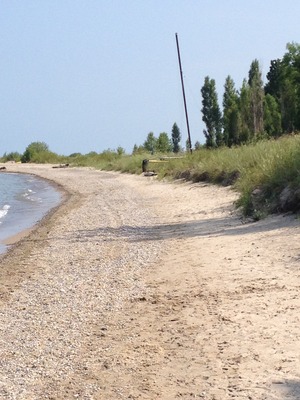
As summer cottagers began their vacations, some had to wonder where their beach had gone. Particularly in dune areas, the shoreline appeared to be overtaken with dune grasses. What actually happened was a confluence of natural processes.

After Lake Huron’s last high lake level in 1997, water levels dropped dramatically in 1998 and stayed well below average for nearly a decade and a half. With the low levels came wide expansive beaches. These open sandy beaches were prone to wind erosion, and sand was  blown and deposited into the dunes as part of their natural re-building process.

Marram grass, a dominant dune grass on Lake Huron beaches,  has its growth rate stimulated by sand burial. The wide open beaches created an opportunity for the grass to grow lakeward. That’s a good thing. If it didn’t grow lakeward, causing the dune to grow wider, the dune would instead grow higher and people would be living beside a vertical wall of sand. Most dunes instead grow wider, toward the lake, building up the sand reserve that helps protect the shore and maintain good quality beaches once higher lake levels return.

Over the past one and a half years, lake levels have rebounded  impressively, rising nearly a metre since the record low in 2013. The wet fall, winter and spring contributed to levels continuing to rise well into July.

image
(Lakeward dune migration, followed by rising lake levels, resulted in a temporary reduction in open beach space. As storm waves erode the dunes, the open beach will widen).

For cottagers, the timing was a bit off. The dunes that had grown lakeward for the past number of years was being met with a rising shoreline, leaving little open sand on which to lay a beach towel. But Mother Nature eventually puts things right. Open beaches are open because of an important process: storm waves. The reason we have open beaches at all is because of storm wave activity. If that were not the case, we would have forests growing right up to the water’s edge.

So the lack of beach in some areas this summer is a matter of timing. Our storm season is still ahead of us. The gales of November produce substantial storm wave energy that causes shore erosion, and the fall and winter storms should  open up the beaches again. Unless, of course, lake levels keep rising. But then you’ll be glad you have those dunes for protection and for sand supply for your beach!

[article by Geoff Peach, Coastal Resources Manager]

Lake Turnover - a natural process, or a tasty dessert?

What is meant by "lake turnover"? How and why does Lake Huron do this in autumn and spring?

The key to these questions is how water density varies with water temperature. Water is most dense (heaviest) at 4º C and as temperature increases or decreases from that temperature, it becomes increasingly less dense (lighter). In summer and winter, lakes are maintained by climate in what is called a stratified (or layered) condition, where less dense water is at the surface and more dense water is near the bottom.

During late summer and autumn, air temperatures cool the surface water causing its density to increase. The heavier water sinks, forcing the lighter, less dense water to the surface. This continues until the water temperature at all depths reaches approximately 4º C. Because there is very little difference in density at this stage, the waters are easily mixed by the wind. The sinking action and mixing of the water by the wind results in the exchange of surface and bottom waters which is called "turnover."

During spring, the process reverses itself. This time ice melts, and surface waters warm and sink until the water temperature at all depths reaches approximately 4º C. The sinking combined with wind mixing causes spring "turnover."

The layering and turnover of water annually are important for water quality. Turnover is the main way in which oxygen-poor water in the deeper areas of the lakes can be mixed with surface water containing more dissolved oxygen. This prevents anoxia, or complete oxygen depletion, of the lower levels of most of the lakes. Which is good! However, the process of stratification during the summer also tends to restrict dilution of pollutants from effluents and land runoff. Which is not so good.

During the spring warming period, the rapidly warming nearshore waters are inhibited from moving to the open lake by a thermal bar, a sharp temperature gradient that prevents mixing until the sun warms the open lake surface waters or until the waters are mixed by storms. Because the thermal bar holds pollutants nearshore, they are not dispersed to the open waters and can become more concentrated within the nearshore areas.

25 - Port Albert
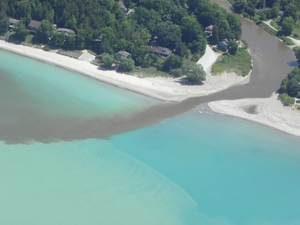
(River plume in spring when river water is warm relative to the lake water. The warmer water 'rafts' over the colder, denser lake water. The dark brown 'tea-like' water in the river plume is caused by tannins from decaying leaves in the river valley. - LHCCC photo, June 8, 2010)

Scientists studying the effects of climate change on the Great Lakes are discovering that water temperatures of the Great Lakes are increasing because of the warmer summer air temperatures and longer ice-free season. Warmer waters could affect the timing and frequency of lake turnover.  In a warmer climate, the turnover may not occur every year in all lakes. Turnover is the main way for deeper lake waters to become replenished with oxygen, and without enough dissolved oxygen, cold water lake fish and other species would be unable to survive in their deep water habitats.

More on Lake turnover - click here.

Have a Guilt-Free Labour Day

Ah, Labour Day. The last long weekend in the year when people go to the beach to forget about work. That may be great for most people. But at the Coastal Centre...the beach is where we work! That's OK. Don't feel guilty. We love what we do. However, if you're sitting on the beach, with a refreshing beverage, thinking, 'those poor super heroes at the Coastal Centre, working to make this beach I'm sitting on so awesome, what can I do to help them?' Well, be guilty no more! You can donate to the Centre...your local beach protectors!

You can donate online through CanadaHelps, or send a donation cheque by mail. For more information on donating to the Centre, visit our donate page.
Member for

12 years 2 months
Submitted by Lake Huron Cen… on

Crying Over Spilled Oil

Oil disasters like the Exxon Valdez and Deep Water Horizon are nightmares that we on the Great Lakes have not had to worry about. At least not yet.

But recent developments in the oil transportation industry compel us to pay attention to proposed and existing oil routes in the Great Lakes region.

In Lake Huron, existing oil pipelines cross the lake bottom in the Straits of Mackinac, and the St. Clair River at Sarnia. Both lines are now transporting crude oil from the Alberta oil sands. That’s different than the regular crude that previously flowed through these lines. Oil sands crude is heavier, and if it gets into water will sink to the bottom. That makes it much tougher to clean up in the event of a spill. And that should be concerning for us in the Great Lakes region who preside over 20% of the planet’s fresh water.

University of Michigan researchers recently modelled what a spill would look like if caused by a pipeline break in Mackinac. The results would impact pristine ecosystems, and would be extremely challenging to clean up.

Meanwhile, a proposal has been made to develop a port in Superior, Wisconsin that would enable shipment of oil by tanker through the Great Lakes. While the issue is currently on hold, it may be just a matter of time before it gets a green light.

Of course, it’s easy to envision the possibility of an oil spill in the abstract, and hypothesize that a cleanup would be extraordinarily challenging. But we’ve had a recent dose of reality. The pipeline break in the Kalamazoo River in 2010 spilled over 3 million litres of oil into this Lake Michigan tributary. Four years later, the cleanup goes on.

A report by the Alliance for the Great Lakes details the issue of oil transport through the Great Lakes, and  outlines many of the shortcomings that we have here in our ability to respond to environmental emergencies, such as spill cleanups.

U.S. Coast Guard officials admit that the region is ill-prepared to deal with a spill of heavy oil on the Great Lakes. This, along with federal cuts to Environmental Emergencies'  capabilities recently, makes the situation a serious concern. We in the Great Lakes should expect much better contingency and response planning. Our two federal governments have already spent billions since the 1970s trying to clean up toxic 'hot spots' around the basin. We shouldn't burden our children and grandchildren with more toxic legacies that result from poor foresight.

[article by Geoff Peach, Coastal Resources Manager]

Going Up!

Levels have continued to climb on Lake Huron. And they are climbing at a time when the seasonal decline is expected. Typically on Lake Huron, the annual lake level trend is to reach a low point in February, begin to rise as snow melt and spring rains flow to the lake. The rise typically continues until early July, and then levels decline during the remainer of the year.

annual water level graph

This year, levels continued to rise into July, August and September.  September levels usually decline fairly dramatically as cooler air begins to blow over warm lake water. This usually draws water levels downward due to higher rates of evaporation.  This year, however, September was cool and wet, and the lake was relatively cool as well. A decrease in evaporation, coupled with inflows from rain and inputs from Lake Superior have kept levels climbing.

Lake levels on Huron have risen sharply from  their record lows in January 2013. Since then, levels have risen around one metre, adding about 53 trillion litres to Lakes Michigan-Huron (the two lakes are hydrologically connected through the deep Straits of Mackinac, so they behave as one single lake).

Read more on how Lake Huron has risen to its highest point in 15 years here.

Halloween and Beaches

What kind of witch likes to sunbathe at the beach?  A Sand Witch. Like the rest of us, sand witches prefer clean, healthy beaches. That's what the Coastal Centre is all about. This Halloween, consider a donation to the Coastal Centre to support its beach conservation work. It'll be just the right potion for a Happy Halloween!

You can donate online through CanadaHelps, or send a donation cheque by mail. For more information on donating to the Centre, visit our donate page.


Member for

12 years 2 months
Submitted by Lake Huron Cen… on
This months headlines...
  1. Holiday Gift Giving Tips
  2. Looking Back – Moving Forward
  3. Holiday Greetings from the Coastal Centre


christmas_beach2
 

Holiday Gift Giving Tips:

A couple of weeks ago, my daughters came up to me and asked me what I wanted for Christmas this year. I thought about it for a minute, and then said “a bag of Salt Water Taffy.” They chuckled. But I was serious. I like Salt Water Taffy.
 
They’ve gotten used to me responding to this annual question with simple requests. Last year I asked for a travel mug from each of their respective universities (I can’t show favouritism). These were not only things I would use, but were meaningful to me - my girls’ alma maters.  Of course, these simple requests also fit well into their student budgets. And everyone benefits. They don’t need to spend a lot of money, they give their ‘old man’ something he really appreciates, and we avoid the trap of commercialism – the giving of unnecessary stuff which ends up in boxes in the basement and then on a yard sale table.
 
It is in this spirit that we offer the following Holiday Tips: rather than piling up "stuff" under the tree, think about what friends and family really need. Give gift certificates, or make a donation in his or her name to a favourite charity (like the Lake Huron Centre for Coastal Conservation!)
 
Consider gifts that don’t have to be wrapped: tickets to concerts, museums, or sporting events, gift certificates, house plants, or even gifts of your own time or gifts you made.
 
We’re learning in our family to ‘keep it simple.’  And if I get my Salt Water Taffy, it will be the best Christmas ever!!!
 
(article by Geoff Peach, Coastal Resources Manager)
 

Looking Back - Moving Forward:

The Coastal Centre has been around since 1998, but how well do you know us, and what we do? Well, here's the quick lowdown.

We are an independent, non-governmental organization dedicated to the conservation and wise stewardship of Lake Huron. The Centre is the only one of its kind in Ontario. We're coastal specialists working to protect the quality of our coast — clean water, great beaches, diverse healthy habitats - the things we gain from our lake.

But we also want to inspire people to help Lake Huron remain a lake of exceptional quality. Lake Huron does  shows signs of stress at times with algae blooms, degraded beaches, invasive species, nearshore pollution –things we could do without. These are all things that, working together, we can help to correct.

The Centre works at the local level, with many partnerships and collaborations. Our Board of Directors are a group of talented volunteers committed to our mission – "To provide leadership and expertise, in cooperation with partners, to achieve a healthy Lake Huron coastal ecosystem."  Our staff are dedicated professionals employing a combined 60 years of coastal science and management experience. And to build on that experience, we have a Board of Technical Advisors with some of the best coastal experts in Ontario (and beyond).  This may not only sound good, but it earned us the Ontario Minister's Award for Environmental Excellence in 2012.

We're moving forward with some exciting projects in 2015.  And while we are always looking for financial support (as every good charity does) we are also looking for volunteers to help out in various ways. If this appeals to you, call the Coastal Centre office (226-421-3029).

If you want more information about the Centre, visit our website at www.lakehuron.ca or give us a call or email.
 

Holiday Greetings from the Coastal Centre Board & Staff:


LHCCC Board Christmas Lunch Dec 5_2014 4
L. to R.:  Murray Blackie, Jasmine Bhurji, Karen Alexander, Stephanie Donaldson, Jo-Anne Harbinson, Pamela Scharfe, Joan Eaglesham, Geoff Peach, Matt Pearson.
Absent:  Alison Lobb, Doug Miller, Dianne Sutter, Donna Stewart


beach-christmas


Bluewater Beach Aug 4 2003 - 39 Andrews Cres - dumped fill 2

Bluffs, Erosion and Climate Change

When it comes to what people can do to deal with climate change, it boils down to two approaches: mitigation and adaptation. Mitigation is about reducing greenhouse gas emissions to the point where they no longer negatively pose a threat to our climate. Adaptation is about people adapting to changing conditions, and developing coping strategies. In the absence of strong leadership to work toward climate mitigation (reducing ‘greenhouse gas’ emissions), local communities are wise to plan adaptation measures to deal with the results of ensuing climate variability. The Great Lakes region needs to prepare for important changes that will affect coastal areas. This article describes one specific coastal ecosystem that the Coastal Centre has recently researched  to better understand what to expect, and how best to plan ahead.

In 2014, the Coastal Centre initiated a research project looking at the impacts of climate change to Lake Huron shorelines – specifically bluffs and gullies. This research study looked at what influence climate variability will have on this type of shoreline, and what communities should be prepared for. Bluffs and gullies were of particular research interest because of their vulnerabilities to erosion and slope de-stabilization.

The study looked at historical trends in precipitation, temperature, lake levels, ice patterns and erosion history to gain some insight into how these factors are projected to change, and how this will affect bluff and gully conditions.

Overall precipitation in the lake basin is expected to increase by 12%, but the pattern of rain and snow is expected to reduce in frequency but increase in intensity. That means that, while we may not get as many rain or snow storms, their intensity will increase. Heavier, intense rain storms will create higher runoff from the land, with a corresponding increase in erosive force.

The study also looked at temperature trends that suggested an overall trend toward higher average temperatures.  This could mean milder winters, which could affect the timing of when ice forms in fall and leaves in spring. Ice formation along the shore protects the shore from erosion, particularly during the fall/winter storm season. Ice formation later in the season could expose shorelines to increased erosion, since this is typically the period of year when the greatest wave energy is present.

Our winters are anticipated to be milder, meaning that those nostalgic winters where it snows in November and stays until April, may be less frequent. More common will be winters with multiple freeze-thaw cycles: snow-melt-runoff-repeat.  This will be problematic in bluff areas for a couple of reasons. First, multiple snow melt and runoff events will increase overland surface runoff causing erosion. Second, repeated freezing and thawing can be destabilizing to slopes, as water gets into deep soil cracks, freezes and expands, prying the soil mass further apart, and weakening the structure of the soil

The report also suggests that how people interact with and manage the lakeshore can and will influence the degree of bluff and gully erosion. Vegetation is fundamental to slowing erosion and providing slope stability. There are many instances where people have removed vegetation far in excess of what should have been removed (often to get a better view of the lake), and this has unfortunately contributed to increasing the erosion process in these areas. This study helps to underscore how such activities will be much riskier under the changing climate.

While the process of erosion is a fact of life along the lakeshore, the changing climate may present us with greater erosion in many locations. Some of this erosion is part of a long term recession process, largely unstoppable in practical and ecological terms. On the other hand, there are areas where the erosion process may be slowed, simply by following some stewardship practices aimed at prevention:

  • Care for the natural vegetation on bluffs and gullies.
  • If you use a septic system, water conservation is important in order to minimize the contribution of water to the bluff area. Too much water to the bluff adds substantial weight to the top of the slope making it top heavy, and the effluent can lubricate the soil particles contributing to slope failures.
  • Managing storm water runoff in a manner that prevents unnecessary erosion and controls the water flow from top of bluff to the beach will help to prevent gullying and slope failures. 

Planning for what’s ahead, and being able to adapt to changing conditions should help local communities better cope with erosion risk in the future. As history informs us, bluff erosion is often met with panicked reaction, where poor and costly choices sometimes get made. ’Plan for the worst, and hope for the best’ – wise words of our elders.  Perhaps this research will help inform the path forward in living with the new realities of our coast.

[Article by Geoff Peach, Coastal Resources Manager. Based on the science report by Jasmine Bhurji, Coastal Geohazard Intern with the Coastal Centre, funded through Environment Canada’s Science Horizons Youth Internship Program.]
 
View the full report here
 
More on Bluff Stewardship


Keeping Watch

coast watchers 8

The Coastal Centre’s “Coast Watchers” volunteer monitoring program is gearing up for another year of information collection on lake conditions. This citizen science program relies on volunteers who dedicate some of their time to collect observational and/or measured data, and report this information back to the Coastal Centre. The information from all Coast Watchers is analyzed and presented in an annual report that is posted on our website.

Coast Watchers are selected from volunters who live along the Lake Huron coastline from Sarnia to Tobermory. We currently have gaps in the Grand Bend to Sarnia area. Anyone wishing to participate in the program from this area should contact Karen Alexander, Education & Outreach Coordinator at the Coastal Centre’s Goderich office (226) 421-3029.  A training webinar is scheduled for April 22nd. Contact Karen to register by phone or email:  karen.alexander@lakehuron.on.ca

 
For more information on Coast Watchers, click here.
 

Speaking of volunteers, Stewardship Grey Bruce is looking for interested people to become part of the Piping Plover Guardian program. For the past eight years on Lake Huron, the endangered Piping Plover has successfully nested on beaches at Wasaga Beach, Sauble Beach, Oliphant’s Sandy Bay and Port Elgin’s main beach. Volunteers are needed to monitor anticipated nesting sites.plover - Stew Nutt 2

Orientation sessions for volunteers will be held on April 30 (2 pm), & June 4 (7 pm) at Sauble Beach’s Community Centre.

To sign up,email:   volunteer@ploverlover.com

Help give these little birds a fighting chance.

Is There Anything Better?

Ah, Spring on Lake Huron – is there anything better? Well, except for maybe Summer on Lake Huron. And Fall can be pretty nice too. The point is that, it’s always great on Lake Huron.

Celebrate Lake Huron’s greatness with a donation to an organization that is dedicated to helping our lake: The Lake Huron Centre for Coastal Conservation. An organization for ALL seasons.
 

To make a donation click here.

Source

The Great Plastic Lakes

Plastic pollution in the Great Lakes is something we’ve reported on in past editions of E-news. It’s a story in which the Coastal Centre made national news coverage in 2010 when plastic pellets began appearing on Lake Huron beaches. The story was covered on CBC’s The National, The Globe and Mail, Vancouver Sun, and many media outlets across the country. It was a story that caught people’s attention as they wondered why plastics were appearing in Lake Huron and then began asking  about the scope of the problem.

As more research was done to look closer into the issue, it became increasingly clear … plastic in the Great Lakes was becoming an emerging issue bigger than most people could imagine. U.S. researchers began trolling the waters of the open lakes and found alarming concentrations of micro-plastics (small particles less than 5 mm. in diameter) floating in the water. Some of these micro-plastics were discovered to have originated from cosmetic products, like soaps, exfoliating creams, toothpaste, and other common products. These barely visible particles (termed micro-beads) were concerning because they were so small, they were passing through filters at sewage treatment plants and getting into the lakes. Neither Canada, nor the United States, has regulations affecting sewage plant discharge of micro-plastics.

Politicians have become aware of the issue. Two U.S. states (Illinois and New Jersey) have already passed legislation banning products with plastic microbeads. Bill 75, The Microbead Elimination and Monitoring Act, has been introduced in Ontario and has passed second reading. The Coastal Centre has written to the Minister of the Environment and Climate Change in support of this Bill. In addition to the proposed provincial legislation, a federal motion was made in Parliament to consider these micro-plastics to be a toxic substance.

In addition to the above, the Coastal Centre also reviewed data on plastic material gathered during beach cleanups. The range and amount of plastic litter on Lake Huron beaches was significant. In 2014, for example, community volunteers helped remove over 10,000 plastic articles from nearly 40 kilometres of beaches. The articles ranged from small fragments to larger ones, including intact beach toys and disposable plastic water bottles.  The number one litter item was cigarette filters, which are composed of plastic fibres.

To gain a better perspective on the magnitude of the plastic pollution issue, the Coastal Centre partnered with a team of graduate students from Western University. The report from this analysis can be found here.

Most recently, a research team from the University of Waterloo published an article titled, “Plastic Debris in the Laurentian Great Lakes: a Review” in the Journal of Great Lakes Research. It looks at all available data, threats to the lakes ecosystems, including links to human health.

Some of the threats raised include:

Micro-plastics act as a sponge that can absorb toxins, like PCBs and heavy metals.

  • Plastic can become ingested by aquatic wildlife, which can cause malnutrition, and accumulation of toxins in tissues.
  • Fish and birds can become entangled in plastic fishing lines and nets that have been discarded or lost in the lake.
  • Plastic can take thousands of years to degrade. In the meantime, accumulations of plastic in the lake environment could become very costly to clean up.

To move toward addressing at least part of this issue, the Coastal Centre, with funding from the provincial Great Lakes Guardian Community Fund, will begin a beach clean-up campaign in selected communities along Lake Huron.  The aim will be to encourage communities to participate in local beach clean-up programs, connected to the national Great Canadian Shoreline Clean-up program, that measure and analyze the plastic debris collected and report back to the community. This is debris that gets discarded by people, and burdens communities with collection, clean-up and landfill costs. This Centre project is aimed toward building some awareness of the issue, and encouraging active involvement in local solutions along the coast. 

This spring, Coastal Centre staff worked with Bruce Power and the Bruce County Museum to deliver the Bruce Power Eco-Mentors Program. Coastal Centre staff taught students in Bruce County about plastic pollution and responsible waste management. This educational unit was made possible through funding from Bruce Power, and helped begin the awareness of the prevalence of this issue on our local shores.

In the longer view, the economic and environmental costs of plastic pollution  will hopefully compel residents in the Great Lakes to re-examine their relationship with plastic, in what we use and what we buy.

Article by Geoff Peach, Coastal Resources Manager

More on Plastics in the Great Lakes – NOAA Technical Memorandum on Marine Debris Action Plan in the Great Lakes

Coastal Centre to Public: “Get Your Butts Off Our Beaches”

There. We said it. We want your butts off Lake Huron’s beaches. Permanently.

We probably should have prefaced the above comments by indicating that we are referring to cigarette filters. Our apologies for the double entendre.

That fact of the matter is that cigarette filters are the top waste discarded on our beaches. And further to our previous article on plastic, it should be known that cigarette filters are composed of plastic fibres. So, these butts are adding to our micro-plastic pollution problem. Not only that, but these filters pose a risk to shore wildlife who mistake the filters for food, and to the younger humanoids that play on our beaches, who can be exposed to toxins within the filters. Most would agree that this waste has no business being on our beaches.
 
Karens Nephew_2014 2

(Coastal Centre staffs nephew surrounded by butts (red circles) on the beach, summer 2014. The butts were removed from his hands seconds before he tried to taste them.) 

This summer, the Coastal Centre will be taking its “Butt Free Beach” campaign to Sarnia’s Canatara Park, Goderich waterfront beaches and Sauble Beach. People visiting these communities will be greeted with information signs that explain the concerns with cigarette filters on beaches, and makes available cardboard ash trays that form into cones that the user fills with sand to extinguish their butts, and when they are done, pours the sand out of the funnel end of the cone leaving the butts in the cone. Then the user can take the filters to the nearest waste receptacle for proper disposal as they leave the beach.  

“Butt Free Beach” was first piloted by the Coastal Centre last summer at Grand Bend and Kincardine. The results were very positive among users, and brought a greater awareness of the issue to many beach-goers.

For more information on the Coastal Centre’s Butt Free Beach program, click here.

Victoria Day, Water Quality and the Coastal Centre

Victoria Day weekend is the traditional start of the cottage season on Lake Huron. Many people commemorate this event by enjoying their favourite beverage. The basis of all quenchables, whether it’s beer coolers, lemonade or even the ice you use to chill it, is WATER. We depend on good water quality for our beverages, and we work, as one of our four priorities, to protect water quality. Ergo, the Coastal Centre protects the quality of your beverages. (Do you like how we constructed that logic?)

To help ensure the future quality of your libations, consider a donation to the Coastal Centre to help our conservation work. Paying it forward for a good drink.

To make a donation click here.

Source

banner 3

Cutting Trees from Bluff Slopes Somebody Didn't Get the "MEMO"

TO:  Inexperienced Lakeshore Landowners

FROM:  The Coastal Centre
DATE:  June 2015
SUBJECT:  Stop Clear Cutting Trees from Bluffs

It’s a recurring issue: clear-cutting trees from bluff slopes along the Huron County shoreline. It suggests that there are still a few people who haven’t gotten the memo. So here it is. Again!!!

Clear cutting trees from a bluff slope to gain a better view of the lake will lead to erosion, possibly even catastrophic slope failure.


slope clearing at Birch Beach 1 3Now here’s why: 

The science is in. There is a cause and effect relationship between woodland clear cutting and mass slope failure.
 
Cutting of trees on slopes leads to a gradual decrease in  stability as a result of the decay of roots that previously acted as tensile reinforcements in the slope. Root decay can also lead to the formation of underground crevices and channels, called "pipes" in a slope that promote erosion by groundwater seepage. Groundwater seepage is often a catalyst for large scale slope failures. Seepage of groundwater from a bluff is very complex, and very expensive to attempt remediation.
 
The removal of tree canopy results in the loss of evapo-transpiration (trees expel a lot of groundwater through their leaves). The loss of trees tends to promote wetter and less secure slopes. Removal of tree cover (canopy)  also results in the direct impact of rainfall to the soil surface, since the tree cover protects the soil by intercepting rain drops  before they hit the surface. Trees also help to reduce surface water runoff velocities, which can erode soil from the face of the slope.
 
One of the troubling things about the removal of large number of trees from coastal slopes is that it typically takes 8 to 10 years for roots to decay, removing that critical stabilization benefit. This long time period can lead people to believe initially that no harm has been done.  But the adverse effects become evident several years later, and the resulting erosion cannot only affect the property on which the trees were removed, but affect neighbouring properties as well.
 
What to do if you want a view:

  1. Forget about that panoramic vista that you’ve seen on postcards. It doesn’t work well on Lake Huron. The trees provide stability to the slope, increasing the lifespan of your property.

  2. You can establish a lake view by opening up a “window,” selectively cutting tree branches.  You’ll get a view, but also retain the trees for slope stability and wind protection.

  3. Hiring a qualified arborist is likely worth the investment to make sure the work is done safely, and without any collateral damage.

  4. Read more on bluff stewardship here.

  5. For information on current shoreline regulations and by-laws, contact your local conservation authority or municipality.

The Coastal Centre has a large array of shore-related information available to all shoreline landowners, but particularly valuable to newcomers to Lake Huron. Understanding our lake and coastal processes is a good investment for long, happy enjoyment of your property.
 
Article by Geoff Peach, Coastal Resources Manager

Be Careful Out There

With beach season underway, being aware of potential dangers is important to a safe and relaxing day on the shore.
 
We’ve talked before about rip currents in past issues, but it’s good to remind yourself of what they are, where they might occur and how to escape if you get caught in one. Check out the Centre’s Beach Safety page, and learn simple tips at the Be Current Smart website. Structures, such as piers and jetties, are notorious places for dangerous currents to occur. Many drownings have occurred around these kinds of structures. Check out this video, “In Over Your Head: a 3-step process for saving your life.”
 
Be cautious of water temperature. Extensive ice cover  over the past couple of winters means that the lake will take longer to warm up. Cold water can zap your energy quickly, and can lead to hypothermia. Know where to find lifesaving equipment  at the beach. Certified Blue Flag beaches are required to have life saving equipment. Only a small number of public beaches on Lake Huron have qualified lifeguards on duty (Sarnia, Goderich  Rotary Cove and Grand Bend).
 
Water quality information is usually available online through local Public Health Units. Links to area Health Units can be found on our Beach Safety page. SwimGuide is a Smart Phone app that may be a useful tool, too.

Oui, We

This June 24, celebrate St. Jean Baptiste Day. He is the patron saint of coastal stewardship. At least, I think I read that somewhere.

To honour this saint, consider donating to the Coastal Centre. We do coastal stewardship. Oui, we!

To make a donation click here.

Source

banner 3

Mayflies When You're Having Fun

One of our cottage rituals each summer growing up was to head outside after breakfast with a broom to sweep the mayflies off the side of the cottage. There would often be hundreds of them each morning. I thought they were kind of a nuisance (mainly because I was the one doing the sweeping). But my father told me of their importance as a food source to fish. Another common name for these insects is fishflies —although that has more to do with the smell emitted when you get large masses of the dead and decaying carcasses.

mayfly  

Mayfly (Hexagenia ephemeroptera — "Ephemeroptera" means "short-lived").

Mayflies,  which are about an inch long, are part of the food web for both fish and many birds. They constitute one of the most important groups of bottom-dwelling animals in streams and rivers throughout the world. They are also found in ponds and  lakebed sediments.

They live most of their lives as small nymphs underwater in lake sediments. While the larvae (nymphs) live in water, the adults are delicate flying insects. Adults usually lack a mouth and so are incapable of eating (or biting). They generally live less than three days after emergence.  In fact, not only do adult mayflies lack mouths, they have no digestive tracts. Their adult bodies are designed for mating: they truly are love machines.
 
Mating normally occurs the same day these insects reach adulthood. Females release as many as 8,000 fertile, oval eggs over the water, scattering them or, in some species, laying them in mass in a suitable place. After depositing eggs on the water surface, the flies die, often falling to the water and floating, sometimes drifting onto beaches in nuisance piles. Others are strongly attracted to and congregate under  lights at night.

Eggs laid on the water surface gradually sink to the bottom and, after a few days or several months, hatch into tiny aquatic nymphs well adapted for living at the bottom of quiet bodies of water or rapidly flowing streams. Some species burrow into the lake sediment to feed on algae, diatoms, aquatic vegetation, other aquatic insects, etc.The naiads spend four or five years on the lake bottom growing before leaving for their day or two of swarming and mating.

Mayflies are a vital link in the food web of freshwater ecosystems, making energy stored in algae and other aquatic plants available to higher consumers (other invertebrates, fish, birds, etc.). Their healthy population means good water quality.
 
Some people think of mayfly hatches as a nuisance, and they can be a bit annoying when they are swarming, especially if you are trying to waterski! But mayflies are a good thing. They are rarely found in degraded bodies of water because their external gills in the nymph stage are very vulnerable to silting and pollution. Mayflies are  used by scientists as an indicator species when testing for environmental quality, and their presence reflects the good quality of the habitat from which they hatched.
 
So the next time you are charged with sweeping off the cottage, or are walking along the beach one evening, trying not to ingest mayflies as they swarm the shore, think to yourself: ‘this may be hell, but at least the water quality is good.’

Article by Geoff Peach, Coastal Resources Manager


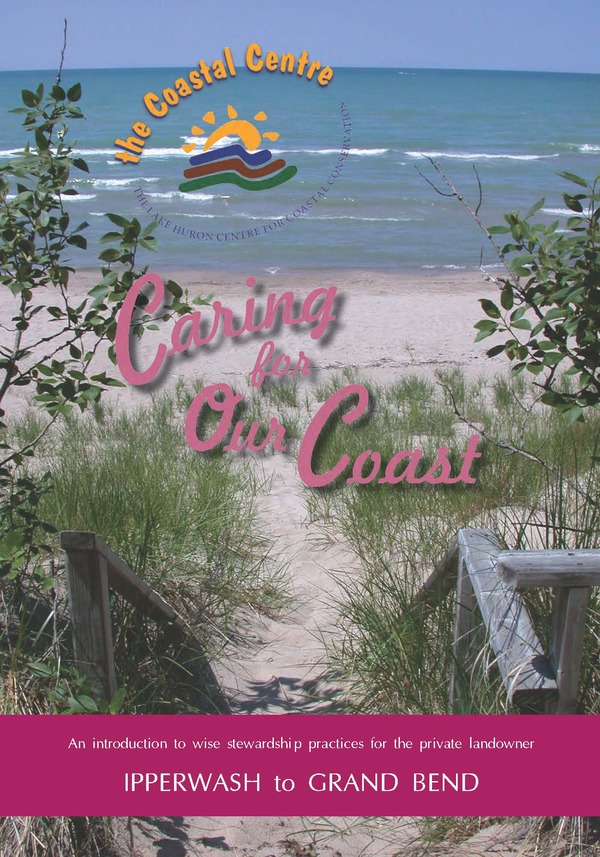
Caring for Our Coast

The coastline of Lambton County, which includes Pinery Provincial Park, is blessed with great beaches of high quality. Keeping them that way is becoming a greater challenge as we face issues such as dune destruction, invasive species infestations, and threats to endangered species, to name a few.

To help maintain a high quality shore, the Coastal Centre has produced a new booklet for landowners and shore users called “Caring for Our Coast.” It contains a range of stewardship tips aimed at averting a degraded shoreline and at improving conditions for wildlife species and people.

Some key tips:
  • Protect sand dunes. They contribute greatly to the high quality of our beaches. Take care not to damage dune vegetation, and use designated pathways or cross-overs as you make your way to the beach.
  • Whatever you bring to the beach, be sure to take back home with you.  Litter, especially plastic waste, can be dangerous to wildlife.
  • Keep motorized vehicles off beaches and dunes. They can be extremely destructive to these ecosystems, can pollute air and water and can contribute to the spread of invasive plants along the shore.
Caring for Our Coast landowner guide - final 2014 low res_Page_01 2
 
To access a copy of the 24-page booklet, visit the Centre’s website (www.lakehuron.ca) or email us at coastalcentre@lakehuron.on.ca


Canada Day on Lake Huron

canada-day

Canada Day on Lake Huron is a thing to behold. Fireworks, music, beer tents. And maybe if you’re lucky, the glorious sound of bagpipes!
 
However you celebrate, it’s a good day to reflect on what a great country we have. And what a great lake we have. You can help us keep it that way by making a donation to support our work in conserving our great lake!

To make a donation click here.

Back to Top

Source

Looks Like a Good Day to Swim, or Is It?

We often get calls every summer from people wondering if it’s safe to swim at one particular beach or another. It can be a tricky question, since  water quality testing is  not universal. What you may think is a public beach might not be considered to be “public” by local public health authorities interpreting provincial guidelines.  Plus, current water testing techniques take water samples, test them in the lab, and produce results usually 24 hours after taking the sample. Conditions can change quickly in 24 hours, so a good test result taken on a Friday doesn’t necessarily mean that swimming on a Saturday is in the same quality of water. A rainfall or increase in wave activity can alter water quality results quickly.

So there are several tools you can use to better inform yourself about the best places to go for a swim.  A relatively new way in Ontario  is to locate a “Blue Flag” beach. Many beaches on Lake Huron have what is referred to as a Blue Flag designation. This is an international program intended to identify beaches that have met a certain set of water quality, environmental, and safety criteria. Going to one of these beaches can at least assure you that a certain standard is being met, and that there is some third-party oversight in how the beach is being managed.

Another way is to use the SwimGuide app for Smartphones. This is a resource that uses water quality data from public health authorities around the Great Lakes. Again, test results are only as good as the  conditions under which the samples were taken.

Public Health Units also post swimming guidelines on their websites. We have linked to the relevant Lake Huron health units on our website here. Each unit determines where it does water testing, so never assume a beach is being tested just because there are a lot of people using it. And while water test results may be out of date before you step in the water, they are useful when the data are taken over a longer time period (several days or weeks) if they show a trend, whether it be good or bad. Some agencies in the US have been working on models to help speed up the process of providing beach quality information to the public by synthesizing testing data with lake conditions.

While apps and flags and test data can help you on your way to determining a safe choice, an additional method to help you verify a good swimming site is to observe conditions. If it has rained in your area within the last couple of days, chances are that bacteria levels will be higher. This is particularly true in places where agriculture is a predominant land use. Wavy conditions should also tell you that lake bottom and beach sediments, which can harbour pathogens like E. coli.,  have been stirred up and re-suspended in the water. Rule of thumb: If you can wade in up to your waist and still see your feet, it should be OK to swim.

bogies beach IAEUITL photo 4

There are numerous agencies and organizations in the Lake Huron region working to improve water quality in the Lake Huron watershed. It’s a long and ongoing process. While progress is being made, some people still don’t get it. Whether it’s leaving dog feces on the beach, or ignoring a malfunctioning septic system, there is still much work to do in linking personal responsibility with lake quality. So while people want assurance of water safety, good, consistent water quality on Lake Huron will take time and cooperation.
 

So, if you're a beach goer looking for a good place to swim, using some good judgement, and the above tools, you can make an informed choice for you and your family. And one day, with everyone’s help, Lake Huron’s waters will be, without question, the best and cleanest in Ontario.

Article by Geoff Peach, Coastal Resources Manager

My Beach is Still Missing, Dude

As a sequel to the original “Dude, Where’s My Beach” article from last year, this article provides an update to lake level conditions.

Last year, we explained that the lack of walkable beaches was due to rapidly rising lake levels, converging with vegetation growth that had aided the build-up of dunes and beach sand over the preceding 14 years of below-average lake levels. We forecast then that fall storms and wave erosion would help readjust beaches, barring any further increases in lake levels. Well, as it happened, levels continued to increase, and beaches remained narrow this summer. In fact, a doubling of June’s average precipitation over the region caused Lake Huron’s levels to increase in July and into August, when typically early July is the start of the decline in the annual cycle.

Levels are over 30 centimetres above what they were at this time last year.  And where levels typically begin to decline over summer months, their continued rise means narrow beaches continue to narrow. Where levels will go from here is anyone’s guess, but beaches will continue to adjust as waves erode the shore and move sand around. The dune erosion that occurs provides sand to the beach and nearshore lakebed, and this helps to lessen the wave energy that erodes the shore. The build-up of sand in the dunes that occurred over the past 14 years is providing the shore protection we need now.

So, dude, how wide your beach is next summer will depend on what happens during the storm season this fall, and whether water levels continue to climb.  Levels will climb if we continue to receive high amounts of precipitation, and lower evaporation if lake water remains cool and we get another cold, icy winter.
 
Background:

Lake Michigan-Huron, (these 2 lakes behave as one big lake hydrologically), saw a rise in water levels from the record-low experienced in January 2013 through December 2014. It was a remarkable one metre increase that almost tied the record rise set in 1950-1951.

Perspective

As we reach the first of August, some might lament that the summer is half over. But we say “we’ve got half the summer left!” That’s the kind of positivity the Centre uses to approach its conservation work. How can you go wrong donating to an organization  that works on hope and optimism, founded on science and informed stewardship?

A donation to the Coastal Centre is a positive, life-affirming act of greatness.

To make a donation, click here.

Source