Ross Klopp
-

The Huron-Kinloss Municipal Election is scheduled for Monday, October 27th, 2014

Attached is information pertaining to your eligibility to participate in this election.

A person is entitled to vote if on Voting Day if the person;

  • Is a Canadian Citizen
  • Is at least 18 years old 
  • Resides in the Township of Huron-Kinloss, or is the owner or tenant of land in Huron-Kinloss, or the spouse of such an individual.
  • Is not prohibited from voting under the Municipal Elections Act or  other law. 

There is no vote for council.  All present council members have been acclaimed.

There is a vote for mayor and the candidates are:  Arthur KOBERINSKI and Mitch Twolan

The attached information and link describes everything about the election process and Voter's List.

Residents can either call 395-3735 to see if they are on the list or they could also email info@huronkinloss.com and we can verify.

More information on the election is available at this link to our website. http://www.huronkinloss.com/election.cfm  including revision forms for those persons who need added to the list.  However, ID is required with this form so at this point additions to the list must essentially be done in person.

If you need anything else please do not hesitate to call.

Sonya Watson
Clerk, Township of Huron-Kinloss
519-395-3735 ext 123


Member for

12 years 5 months
Submitted by Ross Klopp on

“Greater love hath no man than this, that he lay down his life for his friends.” John 15:13

7600 Canadian soldiers who took part in the liberation of the Netherlands  & who lie buried in British Commonwealth cemeteries in that country are testament to this Bible passage.

In May of this year, the KSPB was privileged to visit the Netherlands to take part in the 70th anniversary commemorations of the Liberation of that country and the end of the Second World War.

The Dutch people were wonderful hosts who treated us royally. Before discussing the band trip, I would first like to give some background on the Netherlands and the role of our troops in its liberation.

The Netherlands had managed to remain neutral throughout the First World War. Sadly this was not the case in the Second World War. Although the Dutch proclaimed neutrality as soon as war was declared in September 1939, Germany nevertheless invaded on May 10, 1940. The small Dutch army was no match for the mighty Wehrmacht and the Netherlands capitulated 5 days later on May 15. Thus began 5 years of brutal occupation. The Dutch government and royal family immediately fled to England where they remained until May 1945. The exception to this was Crown Princess Juliana, later Queen, who was evacuated with her 2 young daughters to Ottawa where they lived until the summer of 1945. It was in Ottawa that Princess  Juliana's  & Prince Bernhard's 3rd daughter, Margriet, would be born in January 1943. Princess Margriet has always kept close ties to Canada, visiting countless times and being given honorary Canadian citizenship. She was present at all the major commemorations we attended in Holland this past May. As a way of thanking Canada for sheltering Juliana and her daughters during the war, the Dutch send 100,000 tulip bulbs to Ottawa every year.

Why are the Dutch so grateful to Canada to this day? Why do they have a special place in their hearts for our veterans – their liberators?

By 1944, living conditions in the Netherlands had become intolerable. The economy had been stripped bare. People were beginning to show signs of malnutrition.  On September 17, the Allies launched Operation Market Garden, flooding the skies over Arnhem & Nijmegen with paratroopers. The goal was to seize the bridge at Arnhem (a bridge too far) which would allow the Allies to invade western Germany. The Dutch believed liberation was imminent. In London, the Dutch government in exile ordered a nationwide railway strike in an effort to impede the German military. Unfortunately the airborne invasion failed to achieve the Rhine crossing and only a small portion of the southern Netherlands was liberated. In retaliation for the railways strikes, the Germans placed an embargo on all food imports. This marked the start of what the Dutch refer to as the “Hunger Winter”.

For 9 months, there was no meat, butter, milk available. Potatoes and bread were severely rationed. Sugar beets, which were normally used for cattle feed, were made into a foul tasting mash. Tulip bulbs were boiled to make a meal. House cats and dogs began to disappear. One resident of Amsterdam described the city: “Garbage heaps piled against tree stumps. Starved dogs, warped with hunger, pawing at the heaps. Barefooted people sitting or lying in doorways, begging children with hunched up shoulders & pipe stem legs.. Bodies could not be buried due to lack of wood for caskets. There was no soap. Frequently there was no water, gas or electricity. Dysentery, diptheria & typhoid were rife.”

It is estimated that in 1945, between 16,000 and 20,000 Dutch died of starvation or causes related to severe malnutrition. In total, over 205,000 Dutch people perished between 1940-1945, the highest per capital death rate of any Nazi occupied country in western Europe.

The Canadians performed extraordinary feats from September 1944 to May 1945 in defeating the Germans. Extraordinary because of the waterlogged & flooded terrain as well as the strength of the well defended German positions. The Canadians cleared the Scheldt estuary in October 1944 at a cost of 12,000 casualties, thus opening the port of Antwerp which allowed the Allies to land desperately needed supplies and troops. In February 1945, Canadians cleared part of the western bank of the Rhine at a cost of 15,000 casualties, allowing our troops as well as British troops to cross the Rhine on March 23. By April 15, the maple leaf rather than the swastika flew over the eastern Netherlands. On May 5, 1945, German General Blaskowitz surrendered to Lt Gen Charles Foulkes, commander of 1st Can Corps.

Dozens of personal testimonies bear witness to the remarkable outpouring of gratitude toward the Canadian liberators. They were hugged, kissed and cheered in the streets for days. One Canadian soldier wrote: “Roads and streets everywhere were decorated with flags, bunting and flowers. Dutch people of all ages lined the roads from early morning until late evening shouting and waving as each unit passed. Everyone wanted to ride in a jeep. To say that the joy of the Dutch people was boundless is not an exaggeration. Our troops, many of whom had traveled from Sicily, had never seen such happiness and rejoicing as poured from the hearts and homes in West Holland.”

So, given this background, it is not hard to understand why Canadians are so welcomed by the Dutch and why ties have remained close since 1945.

On May 1, 42 members of the KSPB flew from Toronto to Amsterdam as well as 10 Legions members

who would form a colour party at all the events. Over 100 veterans went as well. Many were on our flight. After take off, the captain paid tribute to the veterans and thanked them for liberating his country. All passengers on the 747 applauded loudly. During the flight, our pipe major and pipe sergeant marched up the aisle playing Scotland The Brave and When The Battle's O'er. When our flight landed in Amsterdam, fire trucks sprayed the plane with great arches of water as a salute to the veterans. Inside the terminal, the mayor of Amsterdam, the chief of the Dutch armed forces and other dignitaries waited to greet us. We were immediately whisked onto our bus and taken to Almelo, a city of 72,000 in eastern Holland, which would be our home base.  We were met by the town crier and our host committee.   

The first major event in which we took part was a commemoration at Grosbeek Canadian war cemetery where 2,617 of our soldiers are buried. Grosbeek is unique in that many of the dead were brought here from nearby Germany. General Crerar, commander of the Canadian land forces in Europe, ordered that no Canadian dead be buried in German soil. We were supposed to play there but unfortunately did not as it ended up pouring rain. The  ceremony there was very moving. The wife of our Prime Minister, Loreen Harper, attended, as well as the Minister of Veterans Affairs, Erin O'Toole, a padre of the Canadian Armed Forces and Major General Richard Rohmer, a WW 2 veteran who lives in Collingwood and has summered for many years at Bruce Beach. After the ceremony, several KSPB members placed special commemorative markers on the graves of Bruce County boys who are buried there. Despite the rain, a couple of our pipers played some laments at the graves.

The following day we were taken to Holten Canadian war cemetery where 1439 of our soldiers are buried. Holten cemetery is located in a beautiful national park. The site was chosen by  Lt Gen Guy Simonds, commander of 2 Canadian Corps, as the place reminded him of back home.  This time the weather cooperated and we were able to play. The KSPB and the Mariposa Pipes and Drums from Orillia formed an honour guard at the entrance to the cemetery and took turns playing for over an hour while people arrived.  Prime Minister Steven Harper and Princess Margriet attended this ceremony. As at Grosbeek, the veterans were seated in the front row. 100 Canadian soldiers stood guard at the Cross of Sacrifice. Many speeches were given by the Canadian and Dutch dignitaries. A children's choir from Victoria BC sang; Canadian and Dutch young people read a poem in English and Dutch entitled “Commitment to Remember”. Many wreaths were placed at the memorial. About 100 Dutch children placed yellow roses on the graves. A helicopter dropped thousands of poppies over the cemetery.  

That evening in Almelo, the band played inside an old chapel. Afterwards we marched, along with some Dutch military drummers, 6 blocks through the city centre to the Rembrance Monument where hundreds of people were gathered. The City Brass Band played several well known hymns, speeches were made, and the Dutch and Canadian national anthems were sung. KSPB played a few tunes. Last Post was played and a minute of silence was observed. Numerous people laid wreaths at the cenotaph.

On May 5, we played at a remembrance ceremony at the town hall. The mayor of Almelo had invited the mayor of the city's twin town in Germany to attend. Afterwards we departed for the big parade in Wageningen. This parade featured 25 bands, both brass and pipes and drums. It took approximately an hour to march through the city. Thousands of people lined the streets waving Canadian & Dutch flags and cheering. The veterans were all in vehicles. Dutch people would run up to them to shake their hands and thank them for what they did 70 years ago. Many Dutch offered them a small glass of the local brandy. People held up signs saying 'forever grateful'. Several planes scattered tulip petals over the city to commemorate  the food parcels dropped by the British and Canadians to the starving Dutch people near the end of the war. As soon as we finished marching and playing, we were whisked onto our bus and taken to a small city called Zutphen. We were given a lovely buffet dinner and then proceeded to do the 3rd parade of the day. Needless to say, by the end of this one, we were exhausted and were extremely glad to get back to our hotel in Almelo.

Over the next few days,  we visited a war museum in Nijverdal, played in Almelo's town square on market day, and also played at several seniors' homes in the area. Our final parade was in Apeldoorn. Huge banners along the route read “Hello Again” and “Thank you Boys”. Although it was  a smaller parade than the one in Wageningen, there were still hundreds of people cheering & waving Canadian & Dutch flags & shaking the hands of the veterans. After the parade, our bus took us the Velodrome for a tribute concert to the veterans. As the veterans and dignitaries, including Princess Margriet, arrived, about 150 pipers and drummers played. The Appeldoorn philharmonic performed and a screen at the front of the stadium showed images from the war.

Our final evening in Almelo, the host committee put on a sumptuous buffet and some entertainment for us at our hotel. The band also played a few tunes. One of our hosts even attempted to play the bass drum to the amusement of all. It goes without saying that we had fabulous hospitality our whole time in the Netherlands and we cannot thank the Dutch enough for making us feel so welcome.

Many of the veterans said as we were leaving 'see you in 5 years!'. Given their advanced age, it is doubtful that any of them will be attending a 75th commemoration of liberation but who knows? The Dutch told us that this 70th commemoration was considered particularly special as it is thought that due to the fact that the few remaining veterans are all in their 90s, this may be the last one. However, it goes without saying that, even if none of our veterans ever cross the Atlantic again, the Dutch people will never ever forget what our troops did and will be forever grateful. 

Member for

12 years 2 months
Submitted by Lake Huron Cen… on

 
Walking for Water
 
Ten years ago, I heard of this unique effort to raise awareness about the plight of water in the Great Lakes. It wasn’t a big, fancy campaign or highly sponsored event. It was three First Nation grandmothers who decided to circumnavigate the shores of Lake Huron, carrying a bucket of water.
 
The symbolism is powerful. For the Anishnaabe people, the responsibility of taking care of the water belongs to the women. Water is considered sacred and the life blood of mother Earth. At various points along their journey, the women  stopped and made offerings and prayers to the water. As they passed through Goderich back in 2005, they made a stop at the beach and made a tobacco offering to the lake. It was a moving ritual to experience. It was a moment to reflect on our lake, and our relationship with it.
 
The concern of First Nations people for the health of the Great Lakes is highly spiritual. Water is more than a commodity or resource. There is a deep reverence toward water and the Great Lakes. To many people in Ontario, water is taken for granted. The Water Walk is an opportunity to learn more about First Nations respect for water, and an opportunity to take pause and think about ways we might be able to have greater respect for water in our daily lives.
 
The 2015 Mother Earth Water Walk began in Matane, Quebec in June and ended in Madeline Island, Wisconsin in August.   

 
11855911_854428654623618_1705812380201030738_n (2)
(Coastal Centre Director, Deb Shewfelt (2nd from right), and Education Outreach Coordinator, Karen Alexander (far right), provide donation to Water Walkers)

This year’s walk was to raise awareness of the potential for oil spills by train derailments across Ontario and Quebec and included concern for ships that may spill oil as they cross the Great Lakes and the St. Lawrence River. Only recently was an oil terminal on the shores of Lake Superior shelved. But that proposal did shed some light into how much oil has the potential to impact the Great Lakes.
 
From ‘pipelines’ to rail transport to ships, there is more at play than most people realize. We talked a bit about this in our E-news last October. While some may believe “the government” has a handle on this, Canada’s federal government cut the Regional Environmental Emergencies Teams (REETs) in 2012,  from six offices down to two. The Toronto office that covered the Great Lakes was one of them. The two offices that are left to service the entire country are in Gatineau and Montreal.
 
The REETs were set up several years ago to allow for a rapid federal response to marine spills. Prior to 2012, the Great Lakes REET held regular training sessions which were open to all levels of government, agencies, municipal staff and non-government organizations. Anyone who might have a role in a spill response was invited to sessions held throughout the Great Lakes. It was an important coordinating measure aimed at getting everyone singing off the same song sheet, should a spill emergency occur.
 
Nothing like that has happened since 2012. I checked with some of my municipal colleagues: it sounds as though those days of collaborative planning between multiple stakeholders and sectors are a thing of the past.

The powerful symbolism of the Water Walkers, and the message they bring, remind us of what we have at stake in the Great Lakes. This year’s effort to make people aware of the risks associated with oil transportation in the Great Lakes region is timely. It should provoke a change in how we plan, manage, or even accept risks associated with oil shipments in, or near, the largest freshwater source on the planet
.


Article by Geoff Peach, Coastal Resources Manager


Beaches Be Crazy
 
For all of you long-term cottagers, you know how powerful winds and waves can be in changing the whole complexion of your beach. Indeed, the beach can change from one day to the next, even one hour to the next. The dynamic nature of beaches means that change is the rule.  
 
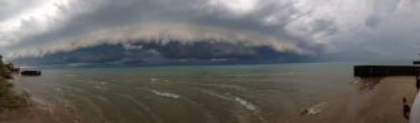
This August was an interesting month for witnessing such change. On August 2nd, an intense storm formed over Lake Huron. It initially caused a strong storm surge, causing many beaches to flood to points last reached in the high lake levels of the 1990's. This was followed by a rapid drop in levels – a phenomenon known as a seiche. The drop exposed large areas of lake bottom as the shoreline moved lakeward by as much as 200 metres. The water soon flowed back. This was followed by an intense rain and lightning storm. The event transformed many beaches, as sands were shifted around, shores were eroded and vegetation displaced.

 
 11825600_853963048003512_716861573553953201_n

(Photo courtesy of Nancy Vidler)
 

Then, at the end of the August, strong winds formed on the lake, resulting from a strong temperature differential between the warm lake and much cooler air blowing across the water. This formed some pretty powerful waves that one doesn’t typically see until Fall, when the temperature differential is more normal. The strong wave energy changed the look of many beaches once again.

A lot of times, seasonal cottagers miss the drama of the lake because summer tends to be the calm season, with relatively gentle waves and lake breezes. There’s always the odd storm, but nothing like what we experience during the gales of November.
 
Beaches (and their dunes) are designed by nature to be resilient to the strong forces of the lake. That’s why beach stewardship and conservation are so important. It’s about keeping the natural infrastructure in place to be present for the unpredictable, dynamic and powerful nature events of our coast.


Extended Summer
 

Labour Day usually means everyone is packing up the cottage to head home for work or school. But here’s a tip. If you can swing  a few more cottage days in September, it’s often the best time of year. Why? It’s still officially summer until the Autumnal Equinox on the 21st. So, you get the summer weather, the lake is at its warmest, and the beaches are typically quiet. That’s valuable advice. Probably worthy of a donation to the Coastal Centre.
 

To make a donation, click here.

Back to Top


Bruce County has created a new government relations department with a mandate to support council and staff with inter-governmental initiatives. The County said in a news release, the new department will provide secretarial support for achieving the goals of the county’s strategic plan, lead government and external relations management, lead strategic communications and issues management, […]

Bruce County has created a new government relations department with a mandate to support council and staff with inter-governmental initiatives. Read More

Tags
Local News, News, Bruce County, Government
Source

The Township of Huron-Kinloss is celebrating 25 years since amalgamation with a special commemorative video. “In 1999, the Township of Huron-Kinloss was formed through the amalgamation of Ripley-Huron, the Township of Kinloss, and the Village of Lucknow. This significant restructuring united our rural and village communities under one municipal government,” the Township said in a […]

The Township of Huron-Kinloss is celebrating 25 years since amalgamation with a special commemorative video. “In 1999, the Township of Huron-Kinloss was formed through the amalgamation of Ripley-Huron, the Township of Kinloss, and the Village of Lucknow. This significant restructuring united our rural and village communities under one municipal government,” the Township said in a […]

Tags
Lucknow Sentinel, Community, Government, Huron, Information, local, Local News, Lucknow, new, News, news release, rural, social, Video, Volunteers
Source

Ann Arbor, Michigan –  A report released by the Great Lakes Commission (GLC) found that 35.4 billion gallons of water per day were withdrawn from the

Ann Arbor, Michigan –  A report released by the Great Lakes Commission (GLC) found that 35.4 billion gallons of water per day were withdrawn from the

Tags
Great Lakes Commission, body, Canadian, Community, council, Department, development, Events, found, Government, Great Lakes, industrial, lake, Lake Superior, lakes, learn, meeting, Michigan, moved, Ohio, Ontario, Other, power, protect, province, Region, report, river, service, support, total, visit, Water, Weather, work
Source

Local not-for-profit Drop-in at the Bridge has launched multiple initiatives tackling food insecurity using an $88,200 seed grant from the provincial government’s Ontario Trillium Foundation (OTF). “Drop-in at The Bridge is empowering families with the skills and resources to build healthier, more sustainable lives, while also creating a sense of belonging and community. I am […]

Local not-for-profit Drop-in at the Bridge has launched multiple initiatives tackling food insecurity using an $88,200 seed grant from the provincial government’s Ontario Trillium Foundation (OTF). “Drop-in at The Bridge is empowering families with the skills and resources to build healthier, more sustainable lives, while also creating a sense of belonging and community. I am […]

Tags
Kincardine News, bridge, Community, Food, Government, local, Ontario, Provincial, sustainable
Source

The Association of Municipalities of Ontario calculated there were at least 1,400 homeless encampments in the province in 2023

The Association of Municipalities of Ontario calculated there were at least 1,400 homeless encampments in the province in 2023

Tags
Lucknow Sentinel, Affordable housing, Association of Municipalities of Ontario, Canada, Canadian, centre, changes, Chatham-Kent, Community, conditions, council, county, Courts, Doug Ford, downtown, emergency, Encampments, end, federal, first, Florida, Ford, found, funding, Garbage, Government, Health, home, Homeless, Homelessness, Housing, Identified, Indigenous, Inflation, Information, Life, local, Local News, Long-term care, man, mayor, Mental health, moved, Municipalities, new, News, Ontario, open, Other, Pizza, play, Police, Policy, Population, province, Provincial, report, river, rural, Rural Ontario Municipal Association, Safety, savings, show, social, Subsidies, summer, support, Thames River, the conversation, Toronto, Trail, US, who, woman, women, work
Source

No shadow, spring is on the way. South Bruce Peninsula Mayor Jay Kirkland informed the crowd in Wiarton of this year’s Wiarton Willie prediction shortly after 8 a.m. Sunday. The crowd began to gather before the 8:07 a.m. prediction, where Wiarton Willie was attended by his Shadow Cabinet, wearing their traditional tuxedoes, after fireworks started […]

No shadow, spring is on the way. South Bruce Peninsula Mayor Jay Kirkland informed the crowd in Wiarton of this year’s Wiarton Willie prediction shortly after 8 a.m. Sunday. The crowd began to gather before the 8:07 a.m. prediction, where Wiarton Willie was attended by his Shadow Cabinet, wearing their traditional tuxedoes, after fireworks started […]

Tags
Lucknow Sentinel, Bruce, Community, Events, Fireworks, found, Government, Groundhog Day, local, Local News, mayor, Media, News, Pennsylvania, Snow, social, South Bruce, south bruce peninsula, Sunday, Toronto, Weather, Wiarton, Wiarton Willie
Source